Current collection update: Arctic Grey Marble is being phased out; Afyon Grey Marble is the recommended collection for new grey-marble projects. Historical project references below retain the material names originally installed.
Black pool coping has become one of the defining details in modern luxury pool design. A black or dark pool edge creates contrast, frames the water, and gives the whole pool a sharper architectural outline. It is a look often used in contemporary backyards, resort-style pools, and clean outdoor living spaces where the water is meant to feel intentional rather than blended into the deck.
The first decision is visual: do you want a crisp black frame, a softer dark grey natural stone look, or a low-maintenance dark porcelain surface? The material comparison matters, but most homeowners should start with design direction, project photography, heat comfort, and edge details before getting deep into technical specifications.
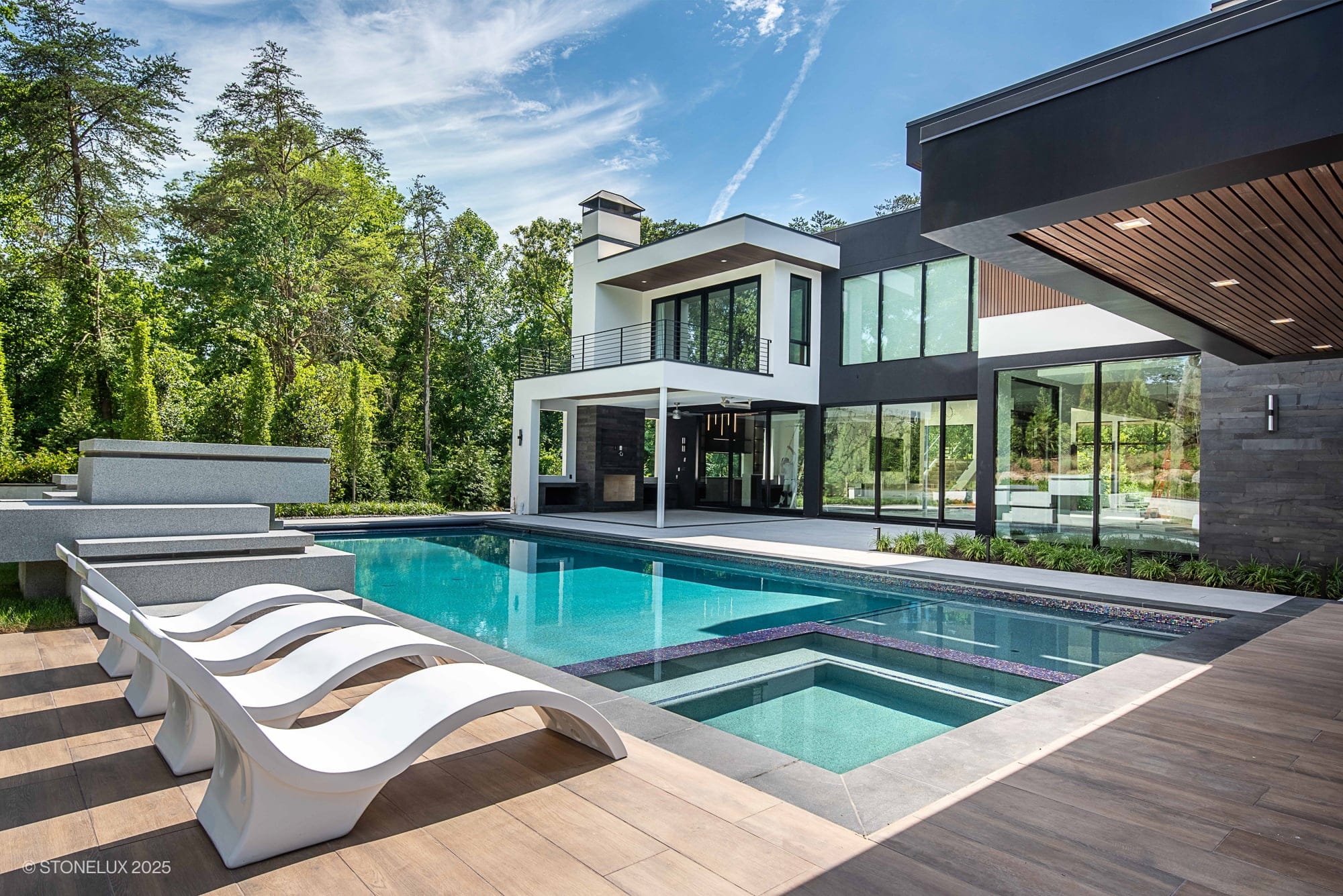
Design reference: Black Basalt coping paired with large-format porcelain pavers creates a crisp modern pool edge.
Why Black Pool Coping Is So Popular
Black pool coping has become popular because it gives the pool a defined architectural edge. Instead of letting the water blend into the deck, the coping becomes a frame. That contrast is especially strong with white plaster, pale decking, light furniture, and clean landscape lines.
The look also connects with broader outdoor design trends: modern resort pools, minimalist patios, darker waterline tile, and high-contrast outdoor living spaces. Black coping can make a pool feel more custom without requiring every surrounding surface to be dark.
Modern architectural pools use dark edges to create a cleaner outline around the water.
White plaster and black coping create one of the highest-contrast pool palettes.
Resort-style outdoor spaces often use dark coping with light pavers, umbrellas, and lounge furniture.
Black Basalt can pair with warm stones like Ivory Travertine or cooler stones like Silver Travertine when the goal is contrast without making the entire pool deck dark.
Large-format porcelain pavers can keep the deck visually calm while Black Basalt handles the pool edge.
What Is the Best Material for Black Pool Coping?
For most projects, Black Basalt is the best material to evaluate first when the goal is true black pool coping. It delivers one of the most consistent and refined black natural stone appearances available for pool coping, has stocked coping profiles, and can coordinate with matching wall caps, treads, pavers, veneer, and accessories. That makes it easier to design a complete pool edge rather than solving each detail separately.
Grey marble is usually the better choice when the homeowner wants a softer, more classic luxury appearance instead of a true black outline. Dark porcelain is often the better choice when low maintenance, chemical resistance, and consistent color are the top priorities, but porcelain coping usually requires custom edge planning.
So the short answer is this: choose Black Basalt for the strongest black natural stone design direction, grey marble for a softer high-end stone palette, and porcelain when maintenance matters more than natural stone character.
Black Pool Coping Ideas
Before comparing basalt, marble, and porcelain, it helps to think visually. Black coping works because it frames the water. The surrounding field paver, plaster color, waterline tile, and landscape determine whether that frame feels dramatic, warm, resort-like, or minimal.
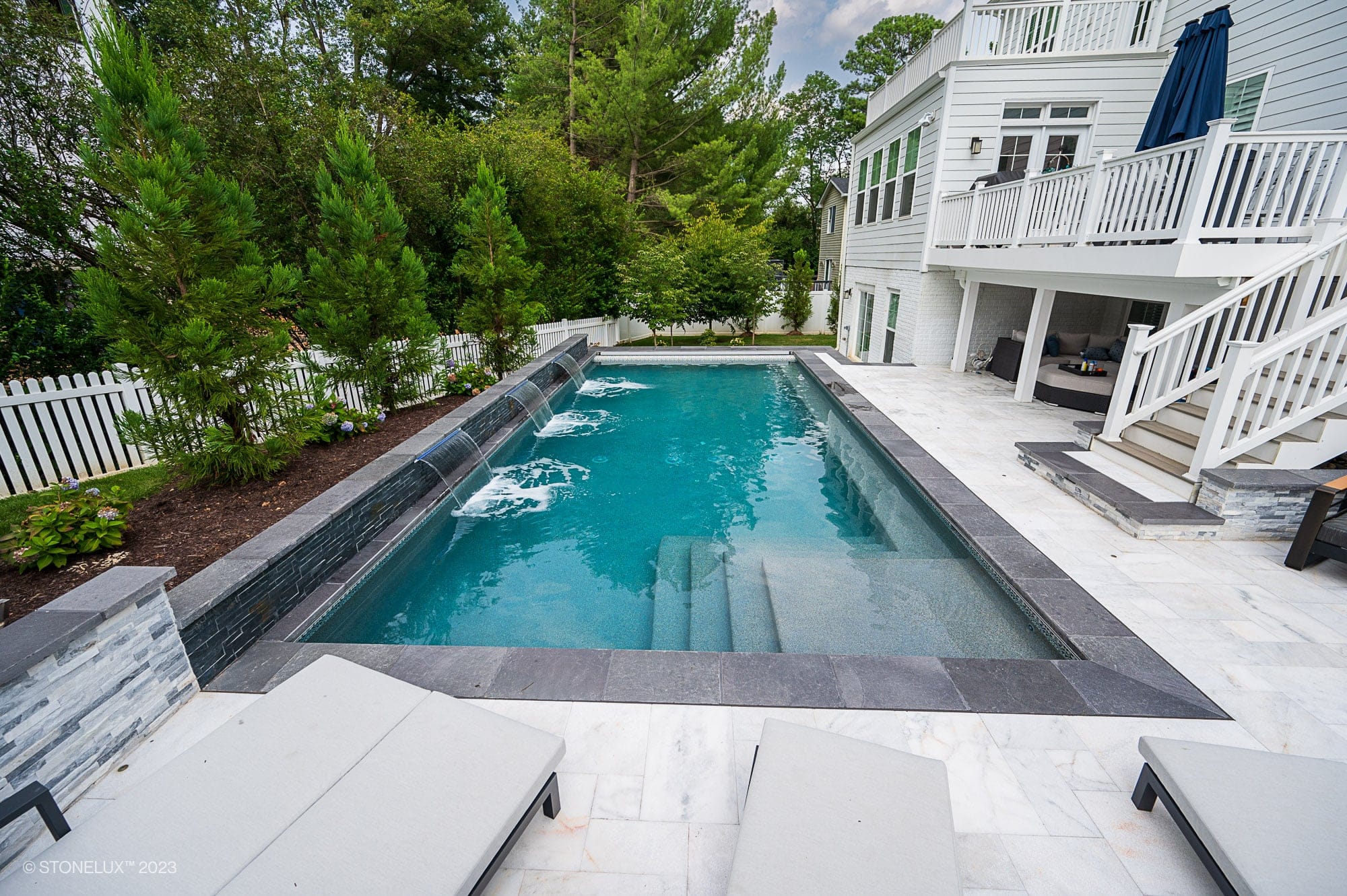
Built example: Afyon White Marble with Black Basalt coping creates a crisp black-and-white pool design.

Built example: large-format porcelain pavers with Black Basalt coping keep the pool deck modern and restrained.
Black Basalt + Ivory Travertine: warm, bright, and Mediterranean-inspired. This pairing is a good direction when the homeowner wants black coping but still wants the deck to feel soft under strong sun.
Black Basalt + Silver Travertine: cooler and more transitional. Silver tones can make the black coping feel less stark than a pure white deck.
Black Basalt + White Marble: the most graphic luxury look. Afyon White Marble with Black Basalt creates strong contrast around blue pool water.
Black Basalt + Large Format Porcelain: clean, contemporary, and lower maintenance for the field paver. This is one of the strongest modern pool directions.
Black Basalt + Dark Waterline Tile: a moodier resort-style design. This works best when the plaster or surrounding deck adds enough contrast to keep the pool from feeling too heavy.
Black Basalt Coping with Travertine Pool Decks
While black pool coping can be paired with many materials, one of the most popular design directions is Black Basalt coping with a light travertine pool deck. The contrast helps define the water while allowing the surrounding deck to remain bright, comfortable, and inviting.
Ivory Travertine creates a warmer Mediterranean-inspired look, while Silver Travertine creates a cooler, more contemporary feel. Both directions give homeowners the visual impact of dark coping without turning the entire pool surround into a dark surface.
This combination is common in luxury residential and resort-style pool design because it balances contrast with everyday comfort. For more background on travertine as a pool deck material, see the travertine pool paver and coping guide.
Quick Recommendation
For most homeowners specifically searching for black pool coping, Black Basalt is usually the strongest starting point. It delivers one of the most consistent and refined black natural stone appearances available for pool coping while offering stocked coping, wall cap, tread, paver, veneer, and accessory options within the same collection.
Choose Black Basalt if you want true black natural stone and stocked coping profiles.
Choose grey marble if you want a softer luxury stone look with natural movement.
Choose dark porcelain if low maintenance matters most and you can confirm the pool edge fabrication early.
Does Black Pool Coping Get Hot?
Yes, black pool coping can feel hotter in direct sun than lighter coping. That is true for black basalt, dark porcelain, and other dark stone or tile surfaces. Heat should be considered early if the pool will be used barefoot during peak sun, especially by children or pets.
The practical answer is not simply "black gets hot, so avoid it." Shade, water splash, the size of the coping band, the color of the surrounding deck, and the time of day all matter. A narrow Black Basalt coping border with a light travertine, marble, or porcelain deck can feel very different from an all-dark hardscape.
Black Basalt typically provides one of the darkest and most consistent natural stone appearances used for pool coping, so it should always be sampled outdoors in direct sun.
Grey marble is usually softer in color and may feel less intense visually and physically than true black stone.
Travertine and light marble are better references if heat comfort is the top priority.
Porcelain can vary by surface color and finish, but dark porcelain should still be treated as a dark surface around bare feet.
Shade structures, umbrellas, planting, and lighter field pavers can reduce the practical heat concern.
Black Basalt vs Marble vs Porcelain: Fast Comparison
Feature | Black Basalt | Grey Marble | Dark Porcelain |
|---|---|---|---|
Color depth | 5/5 - rich natural black appearance | 3/5 - grey to blue-grey | 4/5 - charcoal to black |
Natural look | 5/5 - natural basalt | 5/5 - veining and movement | 2/5 - manufactured consistency |
Maintenance | 3/5 - sealer recommended | 2/5 - more care around chemicals | 5/5 - sealer not required |
Heat performance | 2/5 - darker color typically retains more heat | 3/5 - softer color | 3/5 - depends on color and finish |
Stock coping available | Yes | Yes | Usually custom or fabricated |
Durability | Extremely Durable for any climate. No chipping risk | Durable , chipping risk | High risk for chipping , not repairable |
Best for | Modern black pool coping | Luxury grey pool coping | Low-maintenance dark pool decks |
Black Basalt: Best for True Black Natural Stone Coping
Black Basalt is the clearest choice when the design calls for true black stone pool coping. The Black Basalt collection includes active coping, caps, treads, pavers, veneer, and accessories, which makes it easier to coordinate the pool edge with steps, wall caps, columns, and surrounding hardscape details.
The collection has a deep black tone with a tumbled and brushed texture. Current coping and cap products include eased edge, double eased edge, and triple eased edge profiles in common pool and wall-cap sizes such as 12x24, 14x24, 16x24, and 16x48. Larger pieces such as 24x72 treads and column caps are also available.
From the collection specifications, Black Basalt is listed with Mohs hardness of 6, DCOF of 0.70 dry and 0.57 wet, water absorption of 0.29%, V1 uniform appearance, and sealer recommended. That combination makes it a strong option when the goal is clean, modern black stone with less color movement than many marbles.
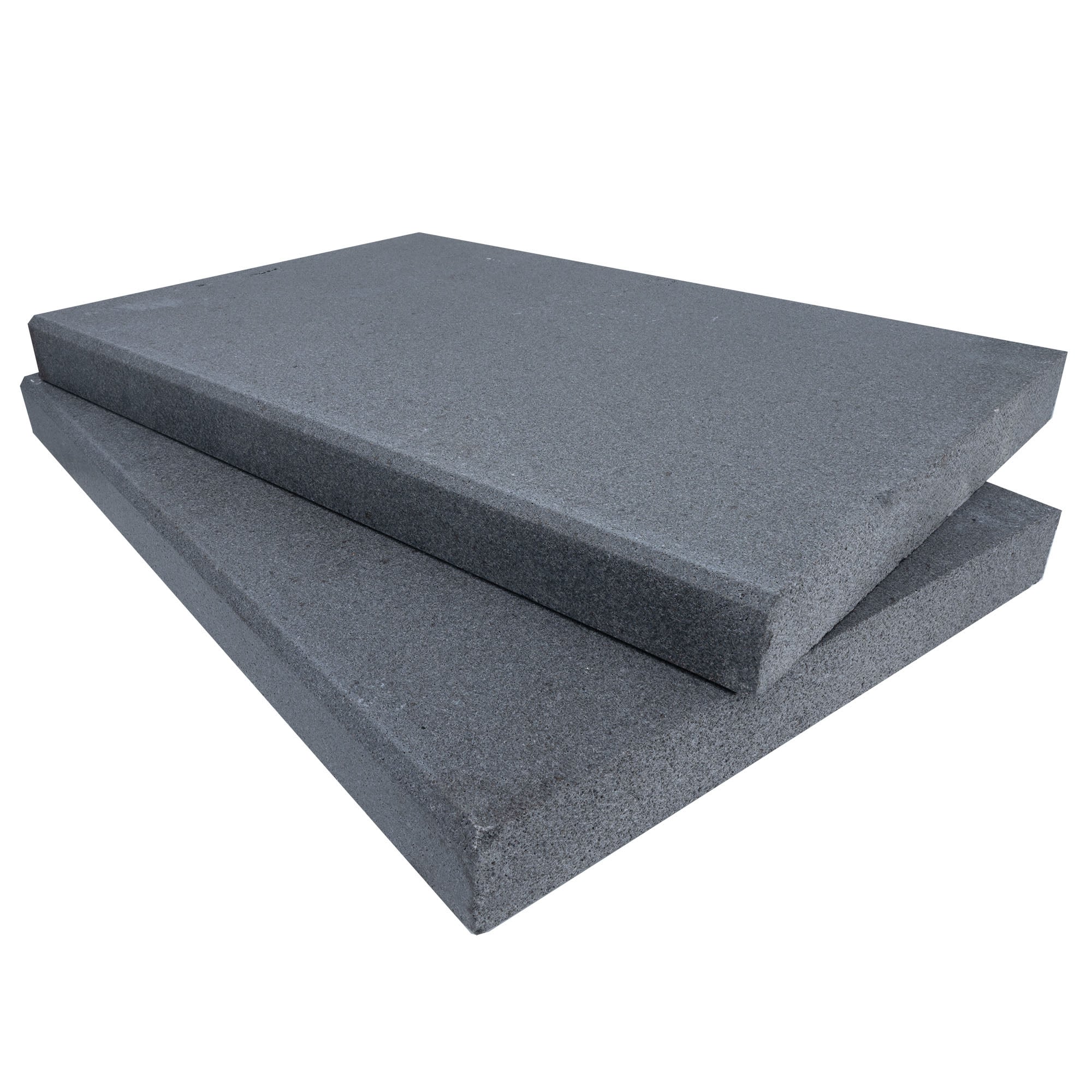
Product detail: Black Basalt eased edge coping gives the strongest true-black natural stone pool edge in the STONELUX catalog.
Black Basalt products to review:
Why Black Basalt Quality Matters
One of the most common surprises for homeowners is discovering that not all basalt looks the same once it is installed.
Basalt quality varies significantly around the world. Quarry source, mineral composition, density, porosity, finishing methods, and manufacturing standards all influence the final appearance and performance of the material. Two basalt products can look similar in photos but perform very differently once installed around a pool.
While black basalt products may appear similar online, differences in quarry source, density, finishing quality, calibration, edge work, and consistency become obvious once the coping is installed around a pool.
In fact, one recent STONELUX customer noted that their basalt coping was "very visibly higher quality than others I've seen of the same material." That observation reflects a reality many contractors and designers already know: premium basalt tends to have better consistency, cleaner edges, tighter tolerances, and a more refined finished appearance.
Color and finish consistency help the black coping read as a clean architectural line instead of a patchwork of mismatched pieces.
Dense, well-finished basalt is better suited to exterior pool details than inconsistent or poorly processed material.
Surface texture matters because pool coping is frequently wet and used barefoot.
Stocked coping profiles reduce design risk compared with trying to fabricate every edge from generic material.
Matching pavers, caps, treads, veneer, and accessories make it easier to keep the whole project coordinated.
This is why the Black Basalt collection is not just a color option. It is a full exterior product family with pool coping, wall caps, treads, pavers, veneer, and accessories that can be specified together.
Marble: Best for a Softer Dark or Grey Luxury Look
Marble is the better direction when the project needs natural movement, veining, and a softer luxury character. The important detail is that these options are usually grey, blue-grey, or light grey rather than true black. Aegean Grey Marble, Arctic Grey Marble, and Tundra Grey Marble are better described as grey marble alternatives to black pool coping.
Aegean Grey Marble offers a deeper grey look with stronger movement and V3 moderate variation. Arctic Grey Marble has a cooler blue-grey tone with V2 slight variation. Tundra Grey Marble gives a lighter grey appearance with a refined sandblasted finish and V2 slight variation.
For pool coping, marble gives designers more visual softness than basalt. It can work well for classic, Mediterranean, transitional, and high-end residential pools. If finish safety is part of the decision, review the related guide on sandblasted vs honed, brushed, and leathered marble.
The tradeoff is maintenance. The marble collections reviewed here list Mohs hardness around 4, chemical and acid resistance as no, and sealer as required or recommended depending on the collection. Around pools, that means pH-neutral cleaning, appropriate sealing, and care with acidic cleaners, hard-water removers, and aggressive pool chemicals.
Grey marble coping alternatives to compare:
Porcelain: Best for Low Maintenance, With an Edge Detail Caveat
Dark porcelain is the most practical direction when the project prioritizes low maintenance, color consistency, and chemical resistance. The Porcelain Paver collection specs list water absorption below 0.1%, Mohs hardness of at least 7, DCOF of 0.81 dry and 0.69 wet with R-11 anti-slip rating, sealer not required, and chemical and acid resistance as yes.
Active dark porcelain options include Blue Stone Black, British Stone Anthracite, Overland Anthracite, and Rasa Gray in 24x24 or 24x48 formats. These are stocked as 2cm rectified porcelain pavers, not as standard coping SKUs. That distinction matters for estimating, lead time, installation planning, and edge design.
Porcelain can still be part of a dark pool-edge design, but the coping condition usually needs to be confirmed as a custom bullnose, laminated edge, or other fabricated detail. The Porcelain Paver collection notes limited custom bullnose and lamination availability. Confirm the coping fabrication path before treating porcelain as a direct replacement for stocked basalt or marble coping.
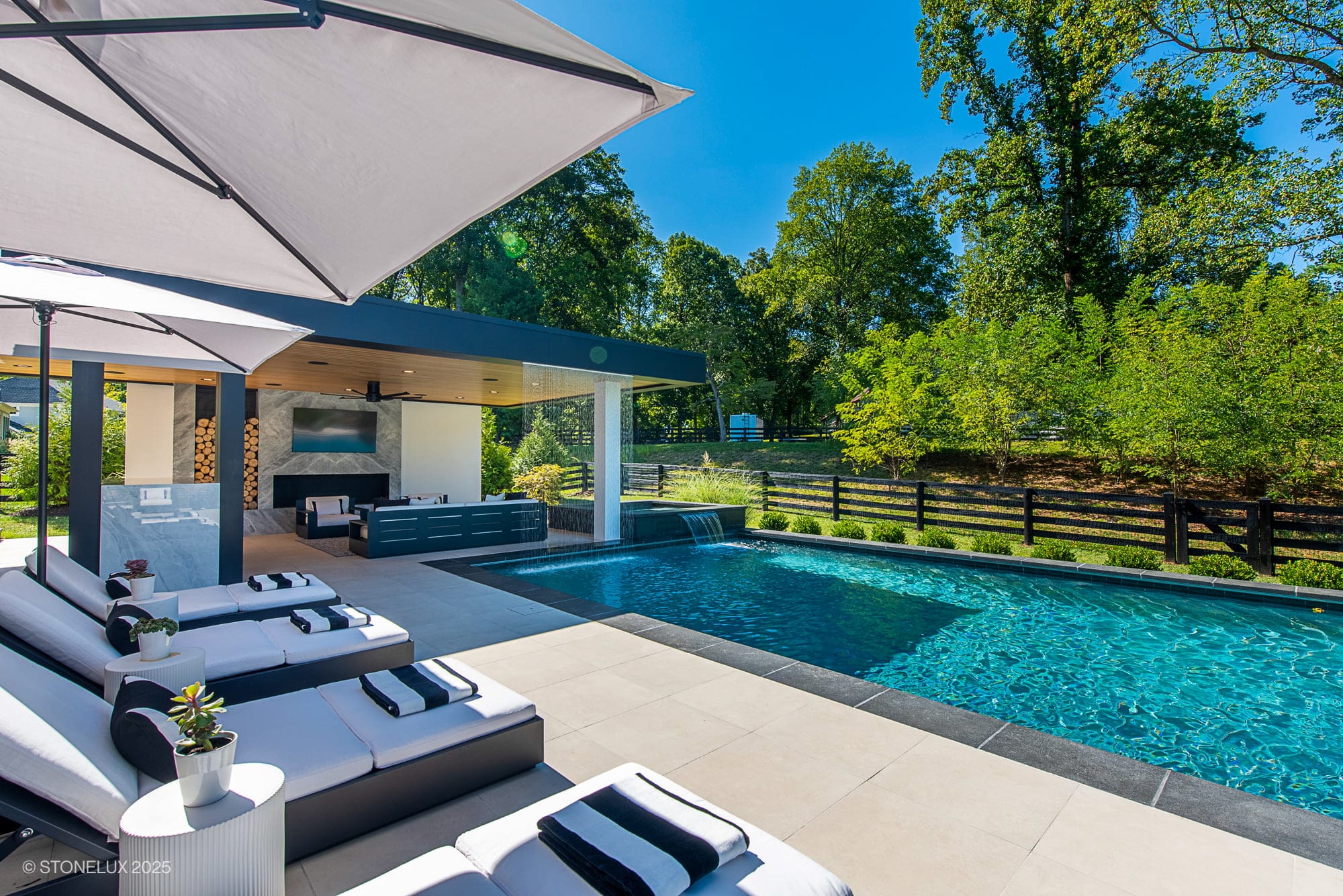
Project reference: porcelain can handle the field paver while Black Basalt handles the pool coping edge.
Dark porcelain pavers to compare when low maintenance is the priority:
Black Basalt vs Black Porcelain Pool Coping
Black Basalt and black porcelain are often compared because both can support a modern dark pool design. They solve different problems. Black Basalt is the stronger choice when the project needs natural stone character and a stocked coping edge. Black porcelain is the stronger choice when the field surface needs low absorption, chemical resistance, and very consistent color.
Natural vs manufactured: Black Basalt is a natural stone, while porcelain is manufactured for consistency.
Edge profiles: Black Basalt has stocked coping, cap, and tread profiles. Porcelain pool coping usually needs custom fabrication or lamination.
Repairability: natural stone can often be blended with replacement pieces from the same collection, while porcelain repairs depend heavily on matching the exact series and batch.
Variation: Black Basalt is listed as V1 uniform appearance; porcelain is also generally consistent but can look more manufactured.
Maintenance: porcelain has the easier technical maintenance profile; basalt gives the deeper natural black look but still needs the right sealer and care.
Basalt vs Marble vs Porcelain Around Pool Water
Pool coping sits in one of the toughest exterior stone locations. It sees sun, water, salt or chlorine systems, cleaning products, foot traffic, furniture, and repeated wet-dry cycles. A material that looks perfect on a sample board still needs the right installation, drainage, slope, sealer plan, and maintenance routine.
Basalt gives the strongest true black natural stone look and stocked coping profiles. Review the related bullnose vs eased edge coping guide before choosing an edge.
Marble gives the most natural veining and luxury movement, but it needs more care around acidic cleaners and pool chemistry.
Porcelain gives the strongest low-maintenance technical profile, but edge fabrication must be confirmed because dark porcelain is stocked primarily as pavers. For slip resistance context, see the non-slip stone guide.
Which Material Should You Choose?
For a modern pool with a dramatic black border, start with Black Basalt. It has the right color story, the right product family, and the stocked coping, cap, and tread support needed for pool edges, steps, wall caps, and related details.
For a project that wants a softer natural stone look, compare Aegean Grey, Afyon Grey, and Tundra Grey Marble. These materials can create a refined pool edge without the visual weight of true black, and they coordinate with pavers and treads when the project needs one stone across multiple outdoor surfaces.
For a project where maintenance is the deciding factor, dark porcelain deserves serious consideration. It is especially useful for patios, roof decks, modern pool surrounds, and projects where stain resistance and chemical resistance are more important than a natural stone edge. Just confirm the custom coping edge before finalizing the design.
Design Notes for Black and Dark Coping
Use a lighter field paver if you want the coping to read as a crisp outline instead of making the whole pool deck feel dark.
Use samples in direct sun before deciding, because black stone pool coping can look very different dry, wet, shaded, and sunlit.
Check edge profiles early. Eased edge, bullnose, wall cap, end cap, and tread details affect both appearance and installation.
Do not choose only by color. Review slip resistance, sealing, maintenance, and fabrication before finalizing the material.
Always review basalt samples both wet and dry. Like most natural stone materials, Black Basalt can appear significantly darker when wet, which can influence how the pool edge looks during daily use.
Products To Compare
Use these product cards to compare the actual STONELUX pieces behind the black coping recommendations. The first group covers the Black Basalt coping, cap, and tread system; the second group shows the lighter deck materials most often paired with dark pool edges.
Related STONELUX Projects to Review
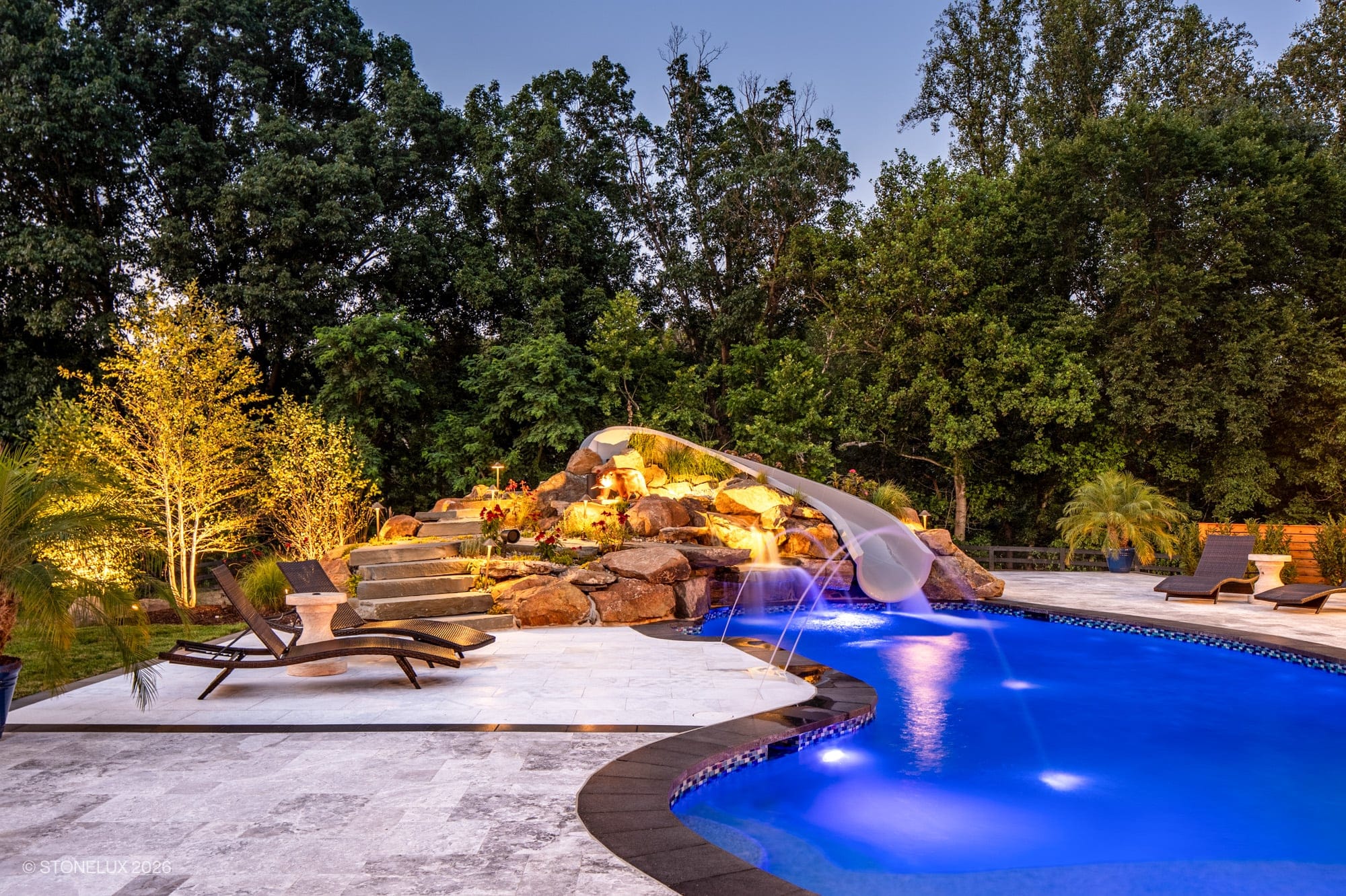
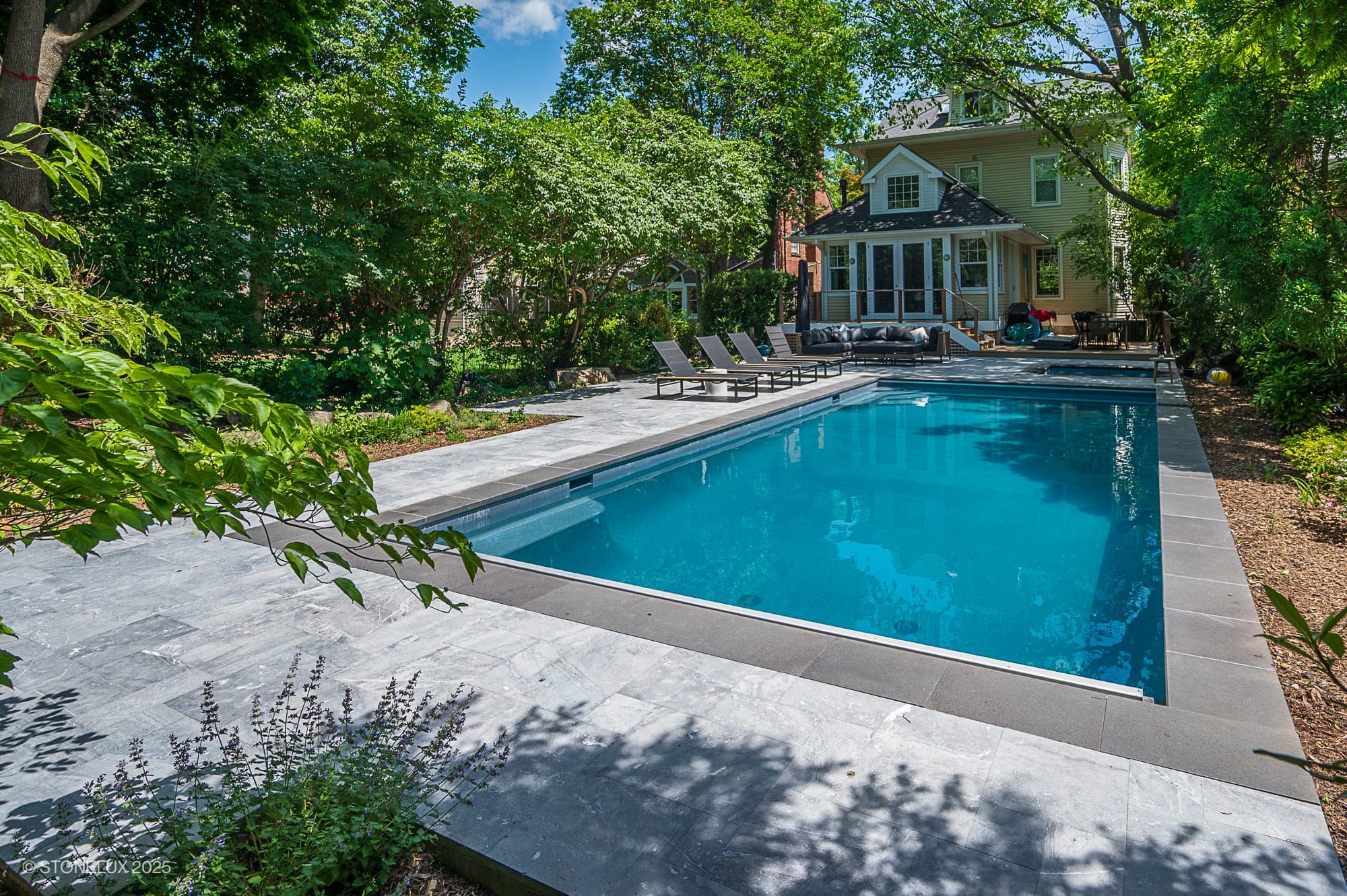
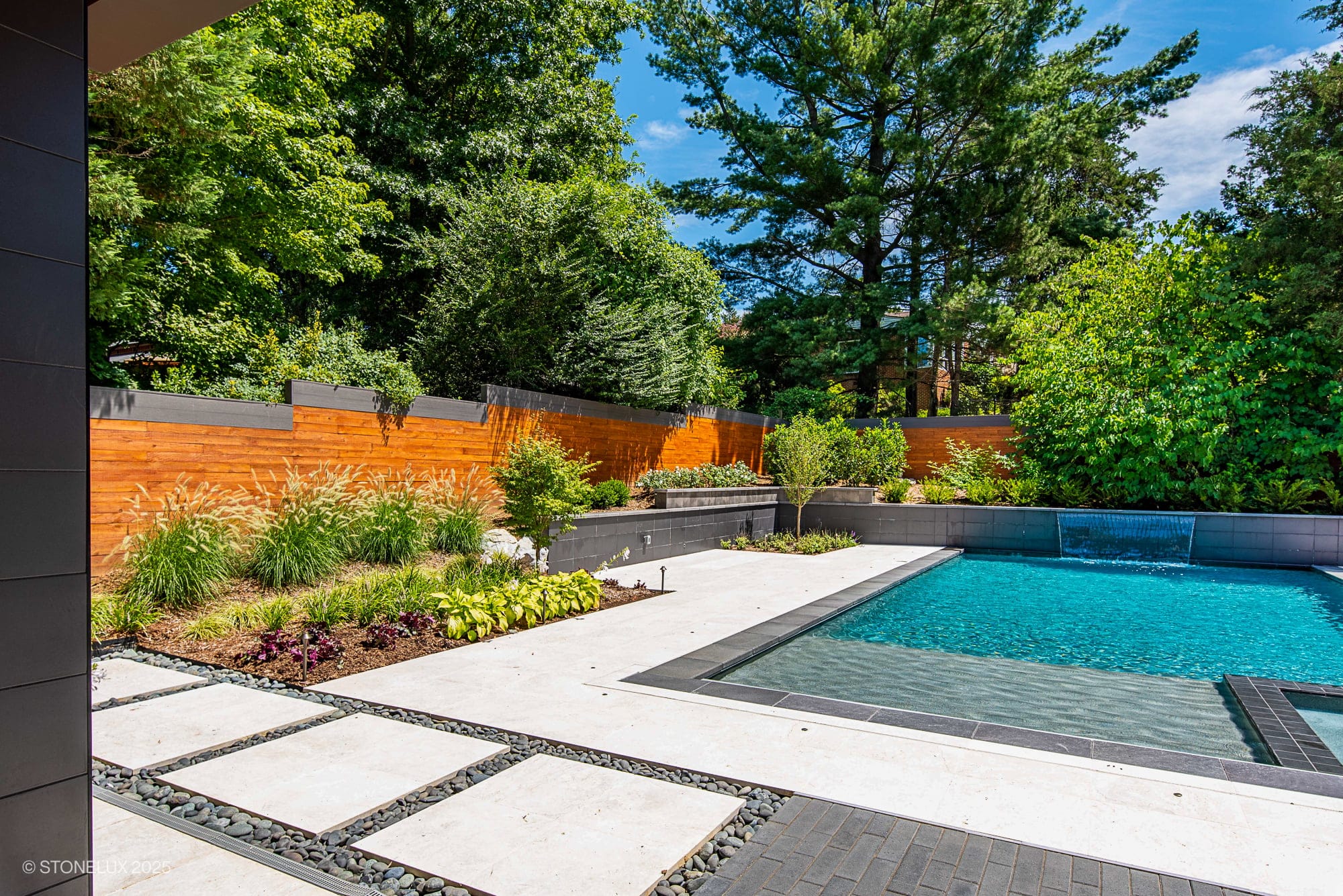
These project references are useful because they show black and dark pool coping decisions in built pool environments rather than isolated samples.
Modern Hillside Elegance - McLean Retreat with Overland Pearl Porcelain & Black Basalt: a clean example of porcelain field pavers with a Black Basalt coping edge.
Aldie Modern Escape - Porcelain & Basalt Luxury Pool Pavilion: useful for seeing how dark basalt coping works beside large-format porcelain pavers.
Urban Serenity Pool Project - Aegean Grey Marble & Black Basalt: a marble-and-basalt reference where grey stone softens the black pool edge.
Backyard Oasis McLean VA with Tundra Grey Marble and Black Basalt: a lighter grey marble comparison point against Black Basalt details.
Modern Monochrome: The Afyon White Marble & Black Basalt Poolside Harmony: a high-contrast white marble and Black Basalt layout.
Project Photos With Product Hotspots
These project photos use interactive lookbook hotspot blocks. Each selected image has active product-backed hotspots so readers can inspect the exact Black Basalt coping, dark cap, marble, porcelain, or travertine product used in the project.
FAQ
What is the best black stone for pool coping?
Black Basalt is usually the strongest starting point for true black stone pool coping because it offers a deep black tone plus stocked coping, cap, tread, paver, veneer, and accessory options in the same collection.
Is Black Basalt good for pool coping?
Yes, Black Basalt is a strong choice when the design needs a modern, uniform, architectural edge. It is listed with V1 uniform appearance, DCOF of 0.70 dry and 0.57 wet, water absorption of 0.29%, and sealer recommended.
Is Black Basalt better than travertine for pool coping?
Neither is universally better. Black Basalt is typically chosen for modern designs that require a darker architectural edge, while travertine is often selected for its lighter color, cooler surface temperature, and Mediterranean character. Many luxury pool projects combine the two by using Black Basalt for the coping and travertine for the surrounding deck.
Does black pool coping get hot?
Dark materials can feel warmer in direct sun than light-colored materials. For barefoot pool areas, test samples outdoors and consider shade, surrounding paver color, furniture layout, and how the pool will be used during peak sun.
Is black pool coping slippery?
Slip resistance depends on the material, finish, installation, slope, and maintenance. Review the specific product DCOF, use exterior-rated finishes, and avoid judging pool coping by color alone.
Does Black Basalt fade?
Basalt is a natural stone, so the color is not a surface print like some manufactured materials. Outdoor appearance can still change with weathering, sealer choice, mineral deposits, cleaning methods, and sun exposure, so sample review and maintenance planning are important.
Is basalt better than granite around pools?
Basalt is often chosen when the project wants a deeper black, more modern look. Granite can be durable, but the better choice depends on finish, available coping profiles, slip resistance, color, and project style. For this STONELUX comparison, Black Basalt is the stocked true-black natural stone coping option.
Can porcelain be used for pool coping?
Yes, porcelain can be used in pool-edge designs, but the coping profile must be confirmed. Many porcelain products are stocked as pavers, so bullnose, laminated, or custom edge fabrication may be needed.
Is marble pool coping available in black?
Marble is usually a better choice for grey or blue-grey pool coping rather than true black coping. Aegean Grey, Arctic Grey, and Tundra Grey give a softer natural stone alternative with veining and variation.
What color pool water looks best with black coping?
Black coping works especially well with light plaster, blue water, white or grey field pavers, and dark waterline tile. Lighter plaster and lighter deck materials usually create the strongest contrast.
Do basalt and marble need sealing around pools?
The Black Basalt collection lists sealer as recommended. The marble collections reviewed here list sealer as required or recommended depending on the stone. Use a sealer appropriate for exterior pool environments and follow the sealer manufacturer guidance.
Final Takeaway
For homeowners specifically searching for black pool coping, Black Basalt is usually the best place to start. It delivers one of the most consistent and refined black natural stone appearances available for pool coping, offers stocked coping and matching accessories, and creates the clean architectural edge that has become so popular in modern pool design.
Grey marble remains an excellent alternative when the goal is a softer luxury appearance, while porcelain is often the strongest low-maintenance option for contemporary projects.
The best choice ultimately depends on whether your priority is visual impact, natural stone character, or long-term maintenance. For homeowners seeking a true black natural stone pool edge, Black Basalt remains one of the most proven and widely specified options available today.